
%20cup,%20use%20about%2022%20grams%20of%20coffee%20%E2%80%94%20roughly%204%20level%20tablespoons.%20That%20is%20a%201:16%20coffee-to-water%20ratio,%20and%20it%20is%20the%20right%20starting%20point%20for%20drip,%20pour-over,%20and%20Chem...)
How Much Coffee Per Cup: A Ratio Chart for Every Brewer
For a standard 12 oz (355 ml) cup, use about 22 grams of coffee — roughly 4 level tablespoons. That is a 1:16 coffee-to-water ratio, and it is the right starting point for drip, pour-over, and Chemex. French press goes slightly stronger at 1:15, espresso runs 1:2, and cold brew concentrate runs 1:8.
Ratios are written coffee-first: 1:16 means one gram of coffee for every sixteen grams of water. Water weighs almost exactly one gram per millilitre, so 355 ml of water is 355 grams and the arithmetic stays simple.
The chart below is built around the grind options we actually sell, so whatever you pick on a bag of coffee lines up with a row here.
The coffee-to-water ratio chart
| Brew method | Boxwood grind option | Ratio | Per 12 oz / 355 ml cup | In tablespoons |
|---|---|---|---|---|
| Automatic drip / batch brewer | Drip | 1:16 | 22 g coffee : 355 g water | 4 level tbsp |
| Pour-over (Hario V60) | Pourover/V60 | 1:16 | 22 g coffee : 355 g water | 4 level tbsp |
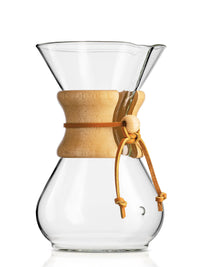
| Chemex | Pourover/V60 | 1:17 | 21 g coffee : 355 g water | 3¾ level tbsp |
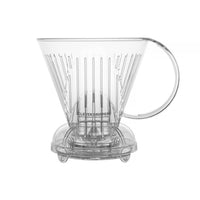
| Clever Dripper (immersion) | Drip | 1:16 | 22 g coffee : 355 g water | 4 level tbsp |
| French press | French Press | 1:15 | 24 g coffee : 355 g water | 4½ level tbsp |
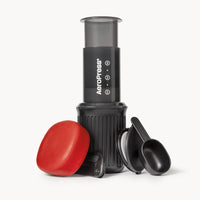
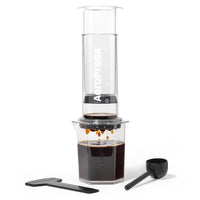
| AeroPress | Drip | 1:14 | 15 g coffee : 210 g water (one brew) | 2¾ level tbsp |
| Espresso | Espresso | 1:2 | 18 g in : 36 g out, in 26–30 seconds | weigh it, do not scoop |
| Cold brew concentrate | Cold Brew | 1:8 | 125 g coffee : 1,000 g water, steeped 12–18 hrs | dilute 1:1 to serve |
| Cold brew, ready to drink | Cold Brew | 1:15 | 67 g coffee : 1,000 g water, steeped 12–18 hrs | pour straight over ice |
Tablespoon figures assume roughly 5.5 g of ground coffee per level tablespoon. They are a fallback, not a method — see below.
Why a scale beats a scoop
A tablespoon of coffee is a volume; a recipe needs a mass. Those two things drift apart constantly. A dark roast is less dense than a light roast, so the same spoon holds less coffee. A coarse French press grind traps more air than a fine espresso grind. Whole beans and ground beans from the same bag measure differently in the same scoop.
The result is that scooping introduces an error of 15–20% before you have even boiled the water — which is more than the difference between a good cup and a bitter one. A $15 kitchen scale removes the variable permanently and is the single highest-return purchase in home coffee. If you are outfitting a setup from scratch, the brewing equipment we stock is what we use ourselves.
Adjusting from the starting point
Treat 1:16 as a baseline and move in one direction at a time.
If the cup tastes weak or thin
Go stronger: 1:15, then 1:14. Add coffee rather than removing water so your brewer's contact time stays roughly the same.
If the cup tastes harsh, drying, or too intense
Go lighter: 1:17, then 1:18. Chemex users often land at 1:17 permanently because the thick filter already produces a very clean cup.
If changing the ratio does not fix it
It is probably not the ratio — it is extraction, and the lever for that is grind. Sour, salty, and thin means under-extracted: grind finer. Bitter, dry, and lingering means over-extracted: grind coarser. Our grind size guide works through the symptoms in detail.
Water temperature and time
Ratio is one of three variables. The other two:
- Temperature: 200–205°F (93–96°C). Off the boil by thirty seconds is close enough. Cooler water under-extracts, especially with light roasts.
- Time: roughly 2:30–3:30 for pour-over, 4:00 for French press and Clever, 1:00–2:00 for AeroPress, 26–30 seconds for espresso, and 12–18 hours for cold brew.
Roast level shifts these too. Denser light roasts want the hotter end of that range and a little more time; medium-dark roasts like our El Jefe extract quickly and can turn bitter if you push them. The light roast versus dark roast guide explains why.
Scaling up
Ratios scale linearly, so a full carafe is just multiplication. For a batch brewer, 1:16 means dividing your total water in grams by sixteen: 1,000 g of water needs 62 g of coffee; 1,500 g needs 94 g.
One practical caveat: very small brews lose proportionally more water to the filter and the brewer itself, so anything under about 15 g of coffee tends to taste weaker than the maths suggests. Brew a little bigger and pour less.
A 12oz bag holds roughly 340 g of coffee, which at 1:16 is about fifteen 12 oz cups — worth knowing when you are deciding between 12oz, 1kg, and 5lb sizes. Whichever you choose, everything is roasted to order in Westfield, New Jersey (we roast Monday through Thursday, and core coffees ordered before noon ship the same day), and you can pick the grind that matches the row you just used. Store what you do not brew properly — the storage guide covers that.